Engineering the James Webb Space Telescope
Lectures
- Date
- 9 Dec 2025
- Start time
- 7:00 PM
- Venue
- Tempest Anderson Hall
- Speaker
- Professor Emeritus Andy Marvin, The University of York

Engineering the James Webb Space Telescope
Professor Emeritus Andy Marvin, The University of York,
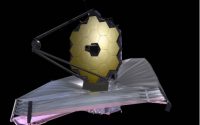
The James Webb Space Telescope produces stunning images of the universe. Often ignored are the engineering challenges overcome in the construction and operation of the telescope. As an engineer, I find these just as interesting and amazing as the images. Let me share some of my enthusiasm.
In this talk I will address the linked engineering issues of;
Where is the telescope and why is it there?
Why is its segmented mirror built the way it is?
How are the images formed by the mirror?
Why does it observe at infra-red wavelengths?
Why is the heat shield built the way it is?
7pm in the Tempest Anderson Lecture Theatre in the Yorkshire Museum on Tuesday 9th December
Please note that thanks to sponsorship from the Yorkshire Branch of the IOP this is a FREE event for everyone.
Member’s report:
Prof. Marvin started his talk by asking “Why observe at Infra Red (IR) Wavelengths?”. There are three main reasons: 1. objects that are cooler emit in the IR. 2. Gas and dust scatter light, but IR is less affected, so you can see through clouds in space. 3. The universe is expanding which causes light to be red shifted – often into the IR. The James Webb (JW) telescope operates near to the so-called L2 point which is located on the opposite side of the earth to the sun and is a gravitationally stable point. If the JW were exactly at L2, the JW would be in the earth’s shadow, so the JW orbits around L2 so that the JW receives energy on its solar cells. The JW needs to be protected from the heat of the sun, so there is a heat shield consisting of five thin Kapton layers which direct the energy sideways by reflecting the heat between each layer. The JW consists of 18 hexagonal mirrors which are folded (as is the heat shield) during launch. The heat shield and mirrors are unfolded after launch in a complicated sequence. The mirrors are then aligned a star which is gradually brought from 18 images to a single image. The mirrors need to be accurate to 10 nm. Prof. Marvin ended his excellent talk by showing an image of the ‘Pillars of creation’, one of the many amazing pictures that the JW has produced.
Chris Walker

 Follow us on Twitter
 Like us on Facebook
 Connect to us on LinkedIn
 Follow us on Bluesky