Fixing Our Mess in Space!
Lectures
- Date
- 10 Feb 2026
- Start time
- 7:00 PM
- Venue
- Tempest Anderson Hall
- Speaker
- Dr Mark Post, University of York

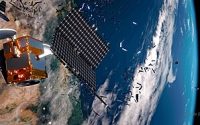
Fixing our Mess in Space!
Dr Mark Post, School of Physics, Engineering and Technology, University of York
Since the 1960s, we have launched thousands of pieces of hardware into orbit of our Earth, many of which are still up there (or in many cases, pieces of them). This is problematic for our future astronauts, scientific and communications satellites, and indeed any beneficial use of space. To ensure that we have a future above our planet, new robotic technologies for satellites and space missions are now being created. Modular satellites that can be assembled and serviced in orbit will replace single-shot launches of large satellites that are difficult to service and challenging to remove from space when they become obsolete. Autonomous networks of robots will perform manufacturing, warehousing, and maintenance in orbit, without risky human spacewalks.
Dr Mark Post received his MSc and PhD in Space Engineering from York University in Canada, and is currently a Senior Lecturer in Intelligent Systems and Robotics at the University of York in the UK. His research focuses on adaptable autonomous robots and cyber-physical systems for space and other challenging and distant environments. He has created autonomous agricultural mapping systems, sensor fusion and control algorithms for orbital and planetary vehicles, tensegrity and bio-inspired land and underwater robots, and communicating modules capable of knowledge-based self-reconfiguration.
7pm in the Tempest Anderson Lecture Theatre in the Yorkshire Museum on Tuesday 10 February 2026.
YPS Members and students free, non members £5.
Member’s report:
The space age started in 1957 with the launch of Sputnik 1. Since then the number of orbiting spacecraft has expanded greatly. Dr Post showed that in 2025, there were 10k active satellites, 13.3k non-active, 60k tracked objects, 500k objects between 1-10cm in size and about 100 million untrackable objects. Objects are being added faster than they can be removed. Although low earth orbit (LEO) objects might return to earth in a few hundred years, geostationary objects never return. In January 2007, a single Chinese anti-satellite test added 150k objects. Although evasive action can be undertaken, this is not possible for some orbits. In 1976 Donald Kessler pointed out that since orbiting objects will collide with each other, then this will eventually lead to a runaway scenario where the earth is surrounded by vast amounts of debris. This became known as the Kessler syndrome. Dr Post then outlined some efforts to remove debris from space such as catching redundant spacecraft with a net or harpoon. Alternatively, powerful lasers shone from the ground could cause small objects to deviate from their orbit and thus be slowed down by earth’s atmosphere. Finally, the idea of modular spacecraft was introduced. This is where spacecraft are constructed in space using modular components. Dr Post showed some of his lab-based modular robots. There is a need for standards in communication between the different modules. Dr Post is involved in several European initiatives such as STARFAB. Let us hope these initiatives will ensure that the space environment will remain for our use for many years to come.
Chris Walker
 Follow us on Twitter
 Like us on Facebook
 Connect to us on LinkedIn
 Follow us on Bluesky