Visit to Quarry Bank
Activities

Our visit to Quarry Bank Mill, south of Manchester, is well worth a full day’s visit, comprising as it does, the Mill, the Apprentice House, Styal Village, Gardens and Estate. Dating back to 1784 and now a Grade II* listed building, Quarry Bank has been called ‘the most complete and least altered factory colony of the Industrial Revolution’ and ‘of outstanding national and international importance’ by the Council of Europe. Originally started by Samuel Greg with technology provided by Matthew Boulton and James Watt (the Lunar Men), thanks to Hannah Greg, the lives of the workers, although still hard, were somewhat alleviated by estate housing, medical attention and education for the apprentices. The mill continued in production until 1959. A well as the industrial buildings, there are acres of woodland to explore along the river Bollin.
Members of York Association of the National Trust (YANT) are most welcome to join us.
The Ingleby’s coach will leave from York Memorial Gardens at 8.45am and we will return to York by 6pm approximately. Lunch is not included, there is both a Café and the Weaving Shed Restaurant or bring a picnic.
For booking instructions and form please click: Visit to Quarry Bank Booking deadline: 4 August 2025
Note that YPS Activities booking terms and conditions will apply and can be seen at the Lodge or online.
Member’s report:
Our coach arrived at this impressive site late morning, and we made our way downhill towards the huge 5 floor mill building next to the river Bollin. Inside there were exhibitions telling how Samuel Greg, a Belfast man came to Manchester with the idea of creating a huge cotton-spinning complex. He and his engineers rerouted the river to power an enormous water wheel to power all the factory machinery. The mill opened in 1784 and for the next 50 years, the valley was transformed with new buildings, landscaping and gardens.
Samuel’s wife Hannah was a religious woman and quite an intellectual. Together they built a family home, Quarry Bank House, next door to the mill. Hannah preferred living here compared to dirty, noisy Manchester and she hosted lively social gatherings and debates here. Quarry Bank House was open for viewing but although few of the original interior artefacts remained, it was still lovely to see the elegant rooms where the Greg family raised their 13 children.
The mill building itself also contained information about what life would have been like for the hundreds of people employed there. Wages were low for such a long day doing a very dangerous job. Whereas men had opportunities for promotion to become engineers or supervisors, women were paid considerably less and rarely had the chance to better themselves. The original mill machinery had been removed but there were a water wheel and examples of many of the machines that would have been there in Samuel Greg’s time brought in from other mills in the area.
Raw cotton was imported to Liverpool and brought to Quarry Bank by road, then later by canal. There were demonstrations showing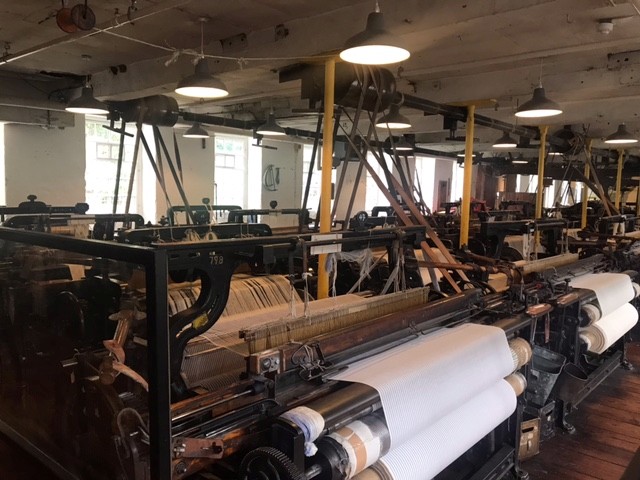 how the cotton was treated and turned into thread, then yarn and fabric. Just one of the machines working was very noisy so we can only imagine what the din would have been like when a whole mill full of machinery was working! The mill employees worked from 6am to 7pm, six days a week. A lot of the employees lived in Styal, a nearby hamlet which was extended greatly by Greg to accommodate the increasing workforce. In the basement there were very impressive working steam engines which were installed later to supplement the waterpower as the river’s speed was inconsistent.
Probably the most memorable part of the visit was our tour of the apprentice house. We were shown round by a most engaging costumed guide. Up to 90 children from age 9 lived here. Many came from workhouses or orphanages as far away as London. We learned how they were given a basic but healthy diet and had the services of a doctor if they became ill, but their life was very hard with no time for play or leisure. After work the boys helped in the vegetable garden and the girls helped with cooking and other housework. On Sundays they went to church twice a day entailing a total 8 mile walk. This left little time for the basic schooling that was provided for them. However, they were looked after and working as a Quarry Bank apprentice was seen as a better option than remaining in a workhouse.
Some of us had time to explore the Chapel Woods, containing folly bridges and exotic trees, where the Greg children could wander. Others of us visited the formal gardens and beautiful glasshouse where exotic fruits would have been grown.
Thanks must go to Dorothy Nott for organising this fascinating trip, and Mick our coach driver.
Rosemary Anderton
Photo: R Anderton
 Follow us on Twitter
 Like us on Facebook
 Connect to us on LinkedIn
 Follow us on Bluesky