Women in Geology
Symposium
- Date
- 15 Nov 2025
- Start time
- 10:45 AM
- Venue
- Tempest Anderson Hall
- Speaker
- Several

WOMEN IN GEOLOGY
Study Day to be held in the Tempest Anderson Hall, Yorkshire Museum, York YO1 7FR
November 15th 2025
A joint Yorkshire Geological Society and Yorkshire Philosophical Society Event
10.45 Welcome and Introduction – Prof. Deborah Smith OBE (YPS President) and David Harbourne (YPS Chair)
11.00 Keynote lecture – Dr. Tori Herridge (University of Sheffield)
11.45 The Pioneers – Dr. Leanne Hughes (British Geological Survey)
12.25 A short history of women in sedimentology. Prof. Cathy Hollis (University of Manchester)
13.05 LUNCH INTERVAL
14.30 Welcome back and YGS Business – Prof. Colin Waters (YGS President)
14.45 Women in Volcanology – who are we, who were we and how do we tell our hidden stories? Dr. Rebecca Williams (University of Hull)
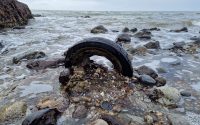
15.25 A new sedimentary cycle: documentation of a rapid ‘anthropoclastic’ cycle. Dr. Amanda Owen (University of Glasgow)
16.05 Discussion and Q&A
16.30 Close
Abstracts and programme for Women in Geology day
This event is open to all; admission free. Advance booking not necessary but places can be reserved at: https://www.yorksgeolsoc.org.uk/events-list/women-in-geoscience-w27ss
Member’s report:
For a day where all the voices, speakers and chairs, were strong, successful, professional women talking about their roles and those of so many previous generations of women in the field of geology, I feel somewhat at a disadvantage in writing some notes on the meeting.
YPS President, Professor Deborah Smith chaired the morning session and invited Dr Tori Herridge (University of Sheffield) to give the keynote address: Mary Anning and the Myth of the Lone Warrier. Dr Herridge is one of the cofounders of the ‘Trowelblazers’ website, celebrating the lives of women in Archaeology, Geology and Palaeontology.At a time when university qualifications and membership of the main reporting societies were men only, she identified both the way that the participation and contribution of women was often masked or overlooked in reports of activities and research and yet those women were often linked in a network with many others collecting, writing, studying anatomy and illustrating discoveries.
Two of her figures were Mary Anning (1799-1847) and Dorothea Bate (1878-1951). Anning had learned about finding and preparing fossils, mainly ammonites, belemnites and gryphaea, from her father in Lyme Regis. She went on to make a series of extraordinary discoveries of Jurassic marine reptiles and learned geology and anatomy to prepare these examples for research and exhibition. In her circle of friends and contacts were Anna Pinney, Elizabeth Philpott, Mary Buckland and Charlotte Murchison. She was not alone and was never forgotten.
Bate was the first woman to work as a scientist for the Natural History Museum. She searched for and identified extinct mammal remains in Cyprus and Crete, finding pygmy hippo and elephant bones. Bate met the American archaeologist Edith Hall Dohan excavating on Crete and later worked in Palestine with geologist Elinor Gardner and Dorothy Garrod, the first woman to hold a professorship at the University of Cambridge when she was elected as Disney Professor of Archaeology in 1939.
Professor Cathy Hollis (Chair of Carbonate Science, University of Manchester) spoke on: A short history of women in sedimentology. Although several of those women studying geology at Newnham College Cambridge went on to field work in the UK and teaching in Palaeozoic sedimentology, the main activity in the 20th century was in mining and petroleum geology where deep seismic surveys, drilling and rig work were male activities at a time when women often left school at 15 and were expected to have children before 21; others were required to resign from the civil service upon marriage. No women were allowed down coal mines and oil and gas rigs had no female facilities. It was the late 1980s when Professor Hollis and others from Aston and Birmingham Universities sought jobs in the oil industry and broke through with few if any female role models. They coped with an after-hours culture with career before family. Part-time and flexible working often came at the price of career progression, but the 2010 Equalities Act has resulted in active recruitment in the extractive industries and universities and there are now nine women who are professors on sedimentology in the UK, and others who play leading roles in professional societies in the field. Professor Hollis cited the GSL publication ‘The Role of Women in the History of Geology’ by CV Burek and B Higgs. The University of Plymouth started the ‘Girls into Geoscience’ project in 2014 and it has since become UK wide.
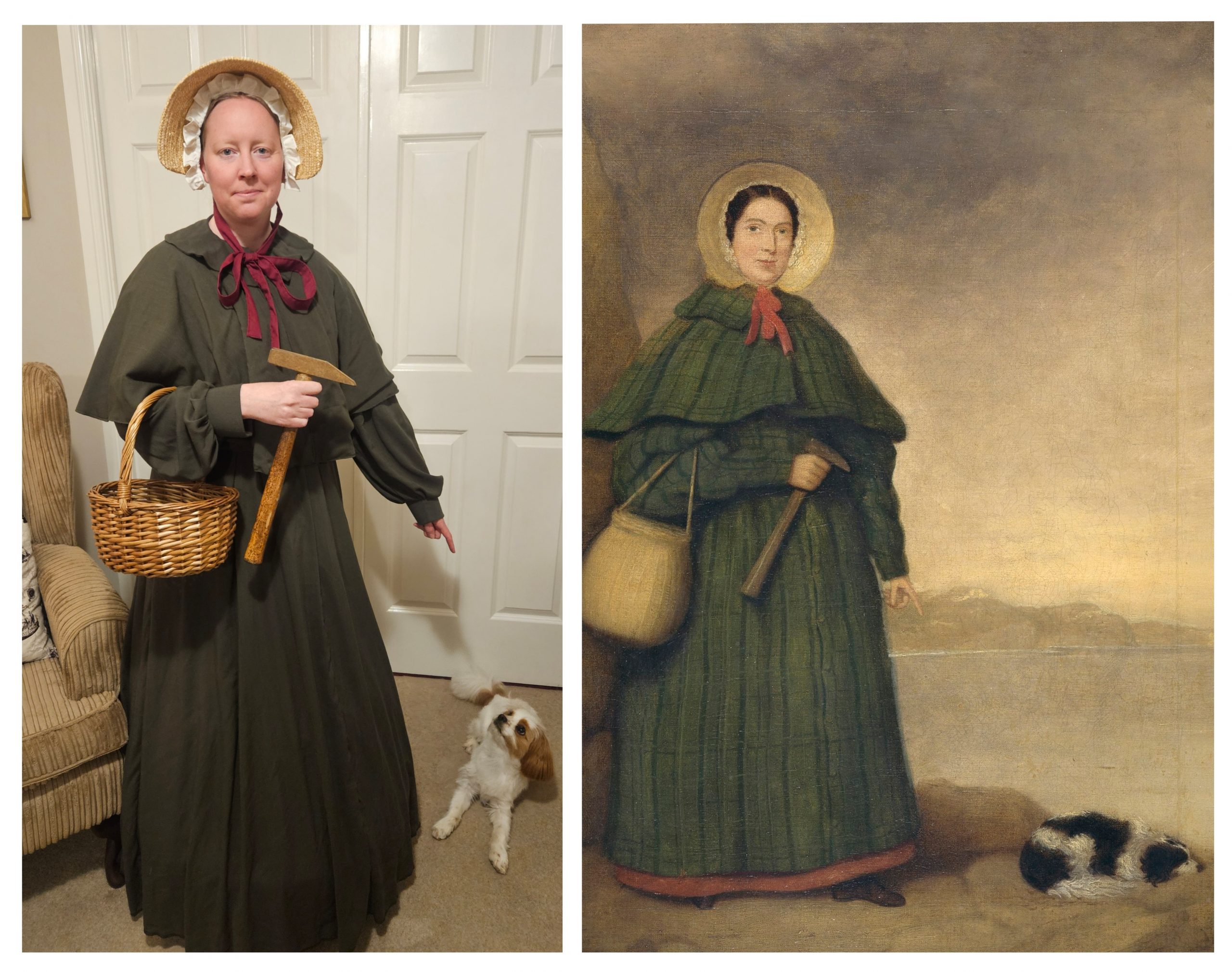
After lunch, Dr Laura Burrel Garcia of the British Geological Survey introduced Dr Leanne Hughes, also BGS, wh gave her talk The Pioneers online. Dr Hughes dressed as Mary Anning and often used this to engage a young audience and focus on the way that women’s contribution to geosciences through history had been poorly recorded, especially when scientific and academic societies disseminating research excluded women. Moreover only women of a certain social status could enter the field, as for example, Mary Wollstonecraft, Etheldred Bennett, Barbara Marchioness of Hastings, Maria Graham Lady Callcott who all wrote or collected and corresponded widely. Charlotte Murchison, who persuaded her husband to give up fox-hunting and take to geology – later founding the Silurian and Permian systems, used her status openly to attend lectures at King’s College London so that other women could not be refused.
Dr Burrel Garcia continued the talk about gender in geosciences and the tension in women’s working lives when there were so few women within an Earth Science field up to the late 20th century and they had to compete on their own terms for positions as well as being seen as role models. Fieldwork practices are becoming inclusive with lone working no longer the default. Guidance was offered to all in posts of responsibility to take care with power dynamics.
Dr Rebecca Williams (University of Hull) has interests in mitigating geohazards and in volcanic science communication. She spoke about Women in Vulcanology and how those figures from the past can be drawn out and future careers supported. Dr Williams noted that the traditional ‘supportive’ depiction of women in science roles on screen differs from the growing number of women having primary roles as can be seen in the membership and activities of the Volcanic and Magmatic Studies Group. A recent film ‘Fire of Love’ has archival footage of Katia and Maurice Krafft working in partnership to film the impacts of eruptions to reduce risks to communities (They died when Mount Unzen erupted in 1991).
Today, there are women in very senior roles: Costanza Bonadonna is the current president of the International Association of Vulcanology and Chemistry of the Earth’s Interior. Katherine Cashman is both a Fellow of the Royal Society and has received the Thorarinsson Medal from the Institution Association of Volcanology and Chemistry of the Earth’s Interior. (IAVCEI). There is, however, more to do to increase the flow from women studying Earth Science and early career workers into senior academic and professional roles – especially for field working among volcanoes. Of those many women from the past who had interests in igneous rocks or travelled and studied volcanoes, Dr Williams singled out Susanna Drury who in about 1740 painted several views of the Giant’s Causeway in County Antrim with such accuracy and detail that many engravings were made and it brought international attention to the site. (We were fortunate that David Alexander brought in a family engraving of the West Prospect of the Causeway for the conference audience to study.) Dr Williams concluded by referencing a paper by Aude Vincent: ‘Reclaiming the memory of pioneer female geologists 1800–1929’, giving details of 210 women undertaking scientific research in geology during these years and many recognised for achievements in their lifetime. How many can you name?
Dr Amanda Owen, University of Glasgow gave a talk based on her own recent research, rather than on historic figures. With extractive industries and transport, humans now have a greater effect on the surface of the Earth than natural processes, but the effects of subsequent redistribution and lithification have yet to be understood. The iron and steel works at Workington poured millions of tonnes of hot, liquid slag over the cliffs at Derwent Howe for a considerable period during the operating of blast furnaces from 1856 to the 1980s. Two kilometres of beach under the cliffs has changed from soft sand to a rocky foreshore and Dr Owen and her team analysed its nature. When looking at sedimentary rocks in classic natural settings, lithification of deposits on land or underwater is measured in thousands to millions of years, but the evidence from objects embedded in deposits at Derwent Howe is that it is less than 35 years old – a rapid ‘anthropoclastic’ rock cycle. Coastal erosion of the cliffs has allowed saltwater and air to mix with the calcium, iron, magnesium and manganese deposits and produce a rapid chemical reaction producing cementing minerals. There are thousands of such sites worldwide with such alkaline material. The only equivalent is volcanic lava. This demonstrates the challenges we face in managing the waste material we’ve produced in creating the modern world. It is going to have an irreversible impact on our future and can fundamentally affect the ecosystems above and below the water, as well as change the way that coastlines respond to rising sea levels and more extreme weather.
The story for the conference is the circumstances of Dr Williams fieldwork which involved covid and two pregnancies with maternity leave in between. Interviews about the published results were from playparks and priorities did change. Her team offered the support necessary for her to be in the field, manage and publish. It was a perfect model for proceeding with field research in so many disciplines.
Paul Thornley
 Follow us on Twitter
 Like us on Facebook
 Connect to us on LinkedIn
 Follow us on Bluesky