Snow White to George Stephenson – the ‘prehistory of railways’.
Lectures

Snow White to George Stephenson – the ‘prehistory of railways’.
Bob Gwynne, Railway Historian and former National Railway Museum Curator
In ‘Rail 200′ Year this talk takes a look at the rather longer history of guided transport than that title suggests. It includes places and people important to what is a complex history and one which stretches from the Gulf of Corinth to the Newlands Valley in Cumbria, from Nottinghamshire to Northumberland. We end with the birth of George Stephenson, the man who is generally regarded as the ‘father of railways’, though he was born next to a waggonway that was already old when he was a little child.
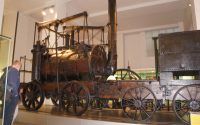
Image: “Puffing Billy locomotive” built in 1813/14 for Wylam Colliery, near Newcastle-upon-Tyne, now in the Science Museum. © Roger Backhouse.
2.30pm in the Tempest Anderson Lecture Theatre in the Yorkshire Museum on Tuesday 9 September.
Member’s report
2025 was flagged as the 200th anniversary of the first modern railway. To mark this event, rail historian and curator Bob Gwynne challenged a large audience to ask what any ‘first’ means, by exploring the evolution of the railway through more than 2,000 years. His thought provoking presentation firstly made us reflect that our in-built desire to imagine a simple ‘first’ when we consider the origin of some new technology is wishful thinking. Our world is much more complex than that. More realistic is the slow coalescence of a number of elements to form any innovation: in the case of the railway a prepared route, a guidance system of flanged rails or wheels, then some form of motive power (first men, then horses, cable haulage by fixed steam engines, then steam and other locomotives). A less obvious requirement is the legal power to acquire the land, control access and charge fares, usually balanced by ‘common carrier’ duties to accept the traffic offered. Bob showed how these elements began to emerge in classical Greece, where remains can still be seen of an engineered route with guidance to convey ships on trollies across the Corinth isthmus. He moved on to the medieval quest for metal ores, where central European miners discovered that productivity (and profits) increased when they laid wooden tracks to guide wagons smoothly and safely along tunnels from the mine workings back to the surface. Central European folklore of this time is preserved in Grimm’s fairy tales, with hints that Snow White’s forest-living seven dwarfs were metal miners. The early railways employed are even illustrated in Disney’s 1937 film.
This took us to the second point – that new technologies rarely emerge in a vacuum. They are a reaction to society’s needs. This was true in medieval Europe, where profit was the driver. By the mid 16th century, England was suffering from the effects of the Reformation. Cut off from much European trade, it needed to develop its own supplies of metals. The Company of Mines Royal brought German mining expertise to this country. This included their transport technology, remains of which have been identified during archaeological excavations in Lake District copper mines of the period. Bob demonstrated how their solutions were noted by English entrepreneurs looking to exploit coal seams more profitably. Relevant records can be found in the Duke of Northumberland’s archives. With a period of colder climates and firewood shortages increasing demand for coal in London and other towns, a technology that reduced the cost of moving coal from mine to coastal shipping points was worth exploring. By 1750 Tyne and Wear coal owners were moving hundreds of thousands of tons of coal each year on their private waggonways, facilitating iron, glass and pottery production as well as satisfying the demands of Londoners and others for cheaper fuel. As a consequence, many of the essential elements of a ‘modern railway’ were in place by the early nineteenth century.
Again, it was an economic imperative that moved things on. The Napoleonic wars raised the cost of horse- and man-power hugely. The solution was to reduce the weight of the stationary steam engines that pumped water and lifted coals from the pits to become wheeled ‘locomotives’ which could replace horsepower. This required innovative, practically-minded engineers to devise new technologies including higher steam pressures and stronger rails. One of these was George Stephenson who had been brought up beside a wooden waggonway and went on to develop ever more useful locomotives. This led to him being hired as engineer to the Stockton and Darlington Railway. This was a proposed ‘common-carrier’ to open up the West Durham coalfield to shipping facilities on the Tees. Most of the elements of a ‘modern railway’ were brought together here for the first time in 1825.
So was the S&DR the first ‘modern railway’? It certainly showed the way but perhaps there was one more element needed. Stephenson and his son, Robert, added the vision and drive to help the emerging ‘modern railway’ move beyond providing mere local solutions towards the creation of a revolutionary national network. In the years that followed, the Stephensons and those they inspired led the emergence of that modern railway nationwide and around the world.
The meeting’s enjoyment of Bob’s presentation was reflected in the lively question and answer session that followed.
Andrew Scott
 Follow us on Twitter
 Like us on Facebook
 Follow us on Bluesky